We’re in the midst of a storm with millions of people in its path. And this one was man-made.
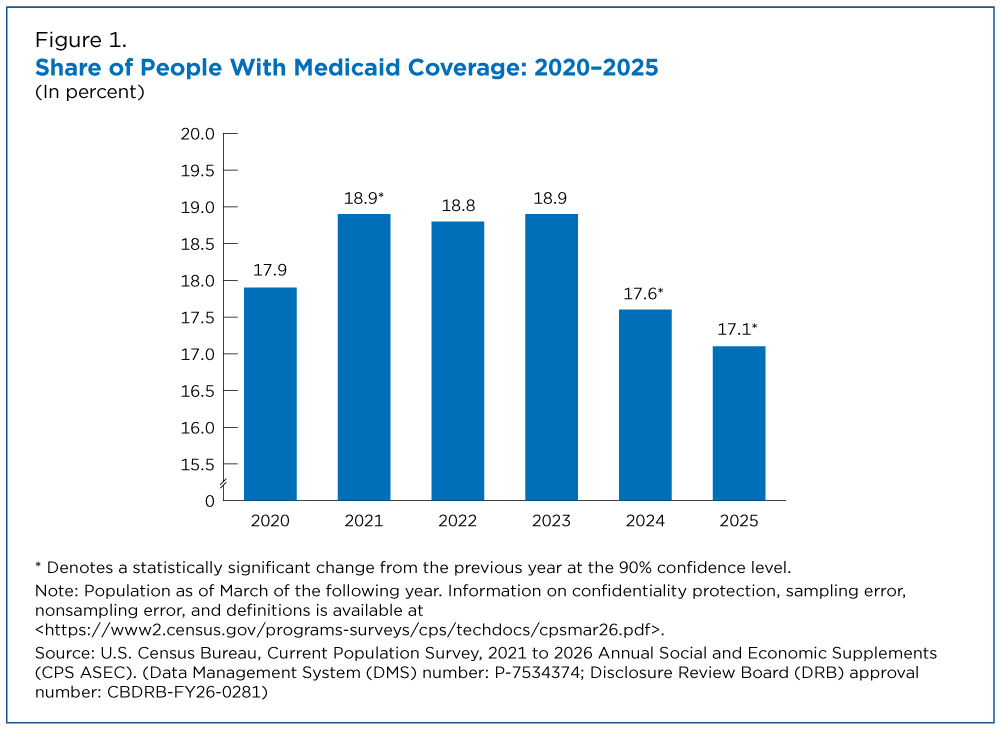
The latest Census Poverty data reveals the ripples of the tsunami in health coverage loss we’re bound to see in the next months and years that will drive millions more into poverty. According to the newest release of Census Poverty data this week, between 2024 and 2025, 1.4 million people lost Medicaid coverage.
There’s been a downward trend of people enrolled in Medicaid from 2021-2025, likely due to Medicaid “unwinding,” when people no longer had the option of continuous eligibility granted through the pandemic period. Medical expenses, in particular, had the largest impact on the number of individuals living in poverty according to the Supplemental Poverty Measure, pushing 7.7 million individuals into poverty, and raising the poverty rate by 2.3 percent – and this is just an early warning.
The biggest restructure of the Medicaid program since its inception came through H.R.1, estimated to cut 7.8 million people off their insurance by 2034. It includes requirements for certain recipients to work in order to receive care and creates frequent redetermination periods.
In a survey conducted by Community Change, one respondent in New Mexico said, “I lost my Medicaid due to reportedly not being disabled. Since I cannot afford co-pays and doctor bills, I have to skip medical treatment… I am drowning in medical debt.”
Laws like H.R.1 create unnecessary bureaucracy and a heavy burden for a health system, including providers and recipients who are already at their wits’ end. High drug costs, a primary concern and stress in many communities, are still higher than in other comparative countries, despite the Trump Administration’s promises to cut costs. Health care premiums, co-pays, and other out of pocket costs shot up after the Affordable Care Act subsidies were not extended at the end of 2025. Families losing healthcare across income levels is creating a situation where families are realizing they are one emergency away from living under the poverty line.
The really scary part is, we expect to see a more precipitous drop in Medicaid and private insurance enrollment next year. The data released today shows changes from 2024 to 2025. ACA subsidy changes are not captured in this year’s Census Poverty data, as they occurred in early 2026 and Medicaid cuts and restrictions are in the process of being determined. So you can imagine there is worse to come.
Unless – we make health justice a defining piece of the agenda. We can choose to abolish poverty in part by crafting a healthcare system that is universally accessible, affordable, and grounded in the interests of community and patients.
What this moment calls for and what ordinary people are demanding is transformational change to our healthcare system into one that ensures health justice where everyone gets the high quality care they need and no one has to go into poverty just to get that care.
The good news is everywhere we go, people are building grassroots power to force transformational change to our healthcare system. In Indiana, organizers with Hoosier Action are building grassroots power to protect access to Medicaid and that the insurance works for all who have it. In Wisconsin, the Milwaukee Black Grassroots Network for Health Equity is creating a model for what free, quality, community-centered care looks like through Health Connections Inc. In Mississippi, the Immigrant Alliance for Justice and Equity is building durable organizing infrastructure under some of the country’s most difficult conditions – restrictive policies and a tough political landscape. In Florida, organizers with Central Florida Jobs with Justice are working to end medical debt in Orange County, a campaign that has already erased nearly $600 million in medical debt benefiting 345,000 residents.
While these places do not necessarily share the same political landscape, the people do share an analysis about the health system: The same corporate forces are extracting from every one of them and they can fight back and win.
It won’t be easy – the Trump Administration is already on the offense, with a concerted effort to mask the data about what its health policies are doing to our communities. They’ve cut federal funding to critical datasets like the Pregnancy Risk Assessment Monitoring System, and removed sexual orientation and gender identity variables from many other datasets. Trump is calling for major changes to the 2030 Census to rid undocumented immigrants and race and ethnicity counts from datasets.
Meanwhile, basic needs programs, designed to create a safety net for communities living within or near the poverty line, are being decimated while wage growth slows and the cost of basic necessities like food, transportation, and housing continues to escalate. People are having to choose between reliable transportation to get to work, accessing healthy food, a stable place to live, or paying for healthcare.
The experience of another one of Community Change’s survey respondents makes clear the dire circumstances people find themselves in when it comes to the cost of health care. She said, “I just moved to Florida from Missouri—where I had Medicaid, as well as Medicare—and recently applied for Medicaid in the Sunshine State. Yesterday, I was informed by letter that my share of cost would be $1,058 a month, leaving about $200 a month from my Social Security check to live on. I require a few medications to live.”
Preventive care in particular goes out the window when people are worried the bill might bankrupt them. This of course means emergency rooms are filled with folks whose ailments could have been caught earlier on – while those same hospitals face closures. Not to mention the stress and anxiety that exacerbates health conditions. More sickness, more chronic disease, more missed work days – all of this is building toward the perfect storm.
We must rewrite the rules to craft a care delivery infrastructure that is accountable to and grounded in the values of community, patients, and workers – and quickly. Not just so people can afford and access healthcare – but so that the care they access is close by, culturally responsive, and comprehensive.
The power to quell the storm, and wake up to clear skies, is in our grassroots movements. It’s time for policymakers to listen to communities and follow their lead.
Isha Weerasinghe is the Director of Public Benefits Justice at Center for Law and Social Policy (CLASP)
Chirag Mehta is the Director of Policy and Ideas at Community Change