When Eimear Roy dies, she says, they should just put her on a paddleboat and push her out to sea.
It’s the cheapest option because her family wouldn’t be able to bury her.
She delivers that line with the same wry humor she brought from Ireland, where she immigrated from nearly a decade prior, and the room laughs, both because it’s funny, and also because it’s not.
“You can’t afford to live,” she said, “and you can’t really afford to die.”
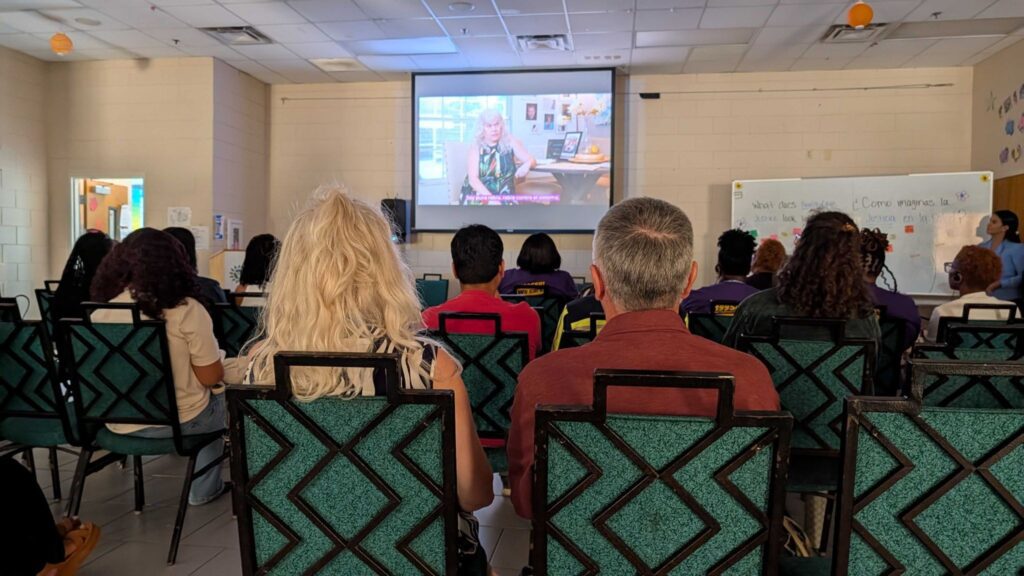
On August 29, dozens of organizers, healthcare workers, and community members gathered at the Hope CommUnity Center for a screening and panel discussion When We Raise Our Hands: Building Community-Centered Care, a new mini-documentary produced by Community Change. The event was hosted in Apopka, Florida by Central Florida Jobs with Justice (CFJWJ), Hope CommUnity Center, 1199 SEIU, and Community Change.
The mini-documentary presented at the premiere is the first chapter in a new series following people across the country building the healthcare system this country hasn’t given them.
The film that screened that afternoon made the case that Roy’s joke isn’t really a joke at all.
Finding throughlines between the stories of two women—Ericka Sinclair, Founder and CEO of Health Connections, Inc. in Milwaukee and Eimear Roy, a healthcare advocate through CFJWJ in Florida—1,200 miles away, fighting the same battles, the documentary showcases that while our healthcare system’s failures cut across geographies, so do community-led solutions.
When the pandemic hit the nation, businesses across the nation shut their doors and health departments redirected their attention to respond to rapidly evolving guidance and priorities. But, Sinclair did not wait for a call, she left her doors wide open.
When a colleague, stunned, asked her why she’d stayed open, her answer was simple: “Because the community needs us now. We can’t wait for your systems to get set up.”
Those systems are exactly what both women are fighting across the country to navigate and Roy’s battle started within her own body.
As a Floridian over 50 with existing chronic conditions, when she was exposed to long COVID it triggered a cascade of new health problems. To make matters worse, she lost her healthcare coverage.
“I decided I wasn’t going gently into anyone’s good night,” said Roy. “I’m going to be part of the solution.”
She’s not alone in that decision. In the room watching her story unfold, and watching another’s over a thousand miles away, at least a dozen more people had made that same call.
Following the screening, a panel, moderated by Registered Nurse Stephanie Estrella, featuring those across healthcare and organizing and community elevated the challenges faced by many in our current system because the issue is universal, but the care is not.
Seft Hunter, Director of Health Equity at Community Change, described how he had to cross state lines to get his mother the care she needed. But, within only 90 days, she sadly passed due to her illness.
And what greeted him, alongside the condolence cards and bouquets, was a $40,000 bill from Medicare.
Kaydra Bonamy, a certified nursing assistant of 22 years and a member of 1199SEIU, recounted how she spent five years making close to 200 trips to the hospital for chronic anemia. She went from 16-hour shifts to transfusions, and she still could not afford health insurance.
Neither could most of her coworkers. “We are working with the sick and cannot afford medical care for ourselves,” she said.
Aracely Roblado, a promotora–a trusted community member who is trained to provide health education, advocacy, and social support–at Hope CommUnity Center, speaks of the struggles many immigrants face seeking healthcare and the need for trust when creating community-centered health facilities.
“Trust is the bridge that connects the community with the services that are needed,” Roblado said, speaking in Spanish.“That bridge cannot break. It has to be stronger every day.”
Community-centered healthcare is what this documentary argues is the one step in transforming a system that treats what happened to Roy, and Hunter’s mother, and Bonamy, and Roblado’s neighbors as unfortunate mistakes rather than built-in flaws.
Later this month, Community Change will release the Powering Health Justice Blueprint: a national framework, drawn directly from communities and stories like these, outlining the healthcare solutions that people really need and using research to create strategies to win.
None of it works, though, if people don’t show up.
“Silence is the enemy,” Roy told the room. “We need to be brave, and we also need to be vulnerable…we have to tell our stories.”
This work is not easy and is born out of much pain due to the failures of this health care system.
“I want to empower you, because you have the ability and power in you to speak up,” said Hunter.
As the floor opened to questions, a woman in the audience raised her hand, stood up—older than most of the panelists, an immigrant from a country she hadn’t lived in for longer than she ever had — and asked a question I imagine many in that room carried silently.
“What can I do to help?”
Healthcare justice, the panel made clear, is only won when people come together and refuse to stay quiet. They encouraged attendees to join an organization already doing this work in their communities, call their local officials, and show up to town halls where decisions are being made. Tell your story, even when it’s easier to stay quiet.
“An injustice against one of us is an injustice against all,” Roy said.
One really hopeful piece of the Powering Health Justice Blueprint is that it’s built so that the next person who raises their hand isn’t starting from scratch – but building on the lessons and wins from people before them.